

Google My Business
The New Digital Front Door
Optimizing your Google Business Profile (GBP)
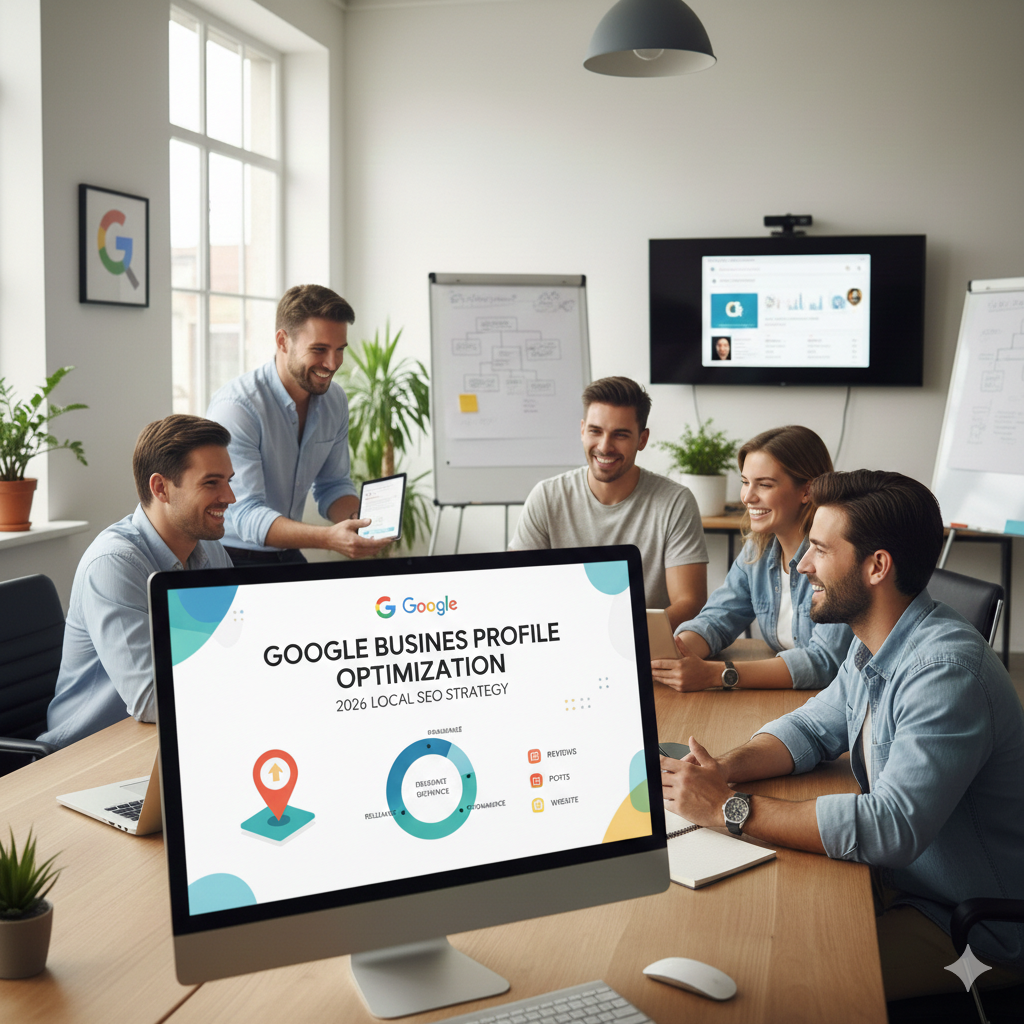
The ultimate guide to optimizing your Google Business Profile (GBP)
1. The Foundation: Perfection in the Basics
Google’s algorithm still relies on the three pillars of local SEO: Relevance, Distance, and Prominence.
- NAP Consistency: Your Name, Address, and Phone number must be identical across your GBP, your website, and every local directory (Yelp, Yellow Pages, etc.). Even a discrepancy like “Street” vs. “St.” can dilute your trust score.
- The Category Lever: This is the single most important ranking signal. Choose a Primary Category that is highly specific (e.g., “Italian Restaurant” instead of just “Restaurant”). Add up to 9 secondary categories to capture broader searches.
Hyper-Local Description: You have 750 characters. Don’t just list services; mention local landmarks, neighborhoods you serve, and specific problems you solve for locals.


- Local Business Schema: Add “LocalBusiness” structured data (JSON-LD) to your website’s code. This tells Google’s bots exactly what your hours, prices, and services are in a language they understand perfectly.
2. Leverage “Live” Signals
In 2026, Google favors active profiles over static ones. A “set it and forget it” approach will see you drop in the rankings.
- Weekly GBP Posts: Treat your profile like a mini social media feed. Post updates, offers, or behind-the-scenes clips. Aim for 1–2 posts per week.
- High-Res, Geotagged Photos: Don’t use stock photos. Upload real images of your team, your office, and your completed work. Google uses AI to “read” your photos to verify you are where you say you are.
- Video Content: 30-second clips of your storefront or a “tip of the day” increase engagement time, which signals to Google that your profile is valuable.
3. The New Review Economy
Reviews are no longer just about the star rating; they are about keywords and velocity.
- Keyword-Rich Reviews: When asking customers for reviews, encourage them to mention the specific service and location.Bad Review: “Great job!”
Great Review: “Best AC repair I’ve had in Downtown Denver.” - Response Velocity: Reply to every review—positive and negative—within 24–48 hours. Use keywords in your replies naturally (e.g., “We’re glad we could help with your plumbing emergency!”).
- Consistency: A steady stream of 2 reviews a week is better for SEO than getting 20 reviews in one day and then none for a month.
4. Master the “Near Me” Strategy
“Near me” is now an implied search. Google uses your proximity to the user, but you can expand your “reach radius” by:
- Seeding your own Q&A: Use a separate account to ask common questions (e.g., “Is there free parking?”), then answer them from your business account. This builds a searchable database of local info.
- Service-Area Business (SAB) Settings: If you don’t have a storefront, define your service area by zip codes or cities. Don’t overreach; keep it within a 20-30 mile radius for maximum relevance.
5. Connecting GBP to Your Website
Your website and your GBP are two halves of the same whole.
- Local Business Schema: Add “LocalBusiness” structured data (JSON-LD) to your website’s code. This tells Google’s bots exactly what your hours, prices, and services are in a language they understand perfectly.
Location Landing Pages: If you serve multiple cities, create a dedicated page for each one with local testimonials and photos.
- Local Business Schema: Add “LocalBusiness” structured data (JSON-LD) to your website’s code. This tells Google’s bots exactly what your hours, prices, and services are in a language they understand perfectly.
Stop being a "hidden gem" and start being the first choice—optimize your profile to turn local searches into loyal customers.
- JBTechLabs.com
Summary Checklist for 2026
Task | Frequency | Impact |
Update Hours/Holiday Hours | As needed | High (Avoids “Closed” filters) |
Post a New Photo/Video | Weekly | Medium (Engagement) |
Respond to Reviews | Daily | High (Trust/Ranking) |
Publish a “What’s New” Post | Weekly | Medium (Freshness) |
Audit NAP Consistency | Quarterly | High (Foundation) |